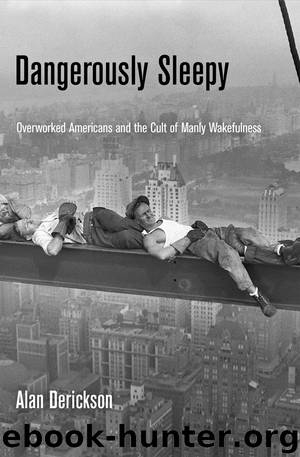
Dangerously Sleepy by Alan Derickson
Author:Alan Derickson
Language: eng
Format: epub
Publisher: University of Pennsylvania Press, Inc.
Conclusion: The Employers’ Dreams
Corporations cherish flexibility, leanness and just-in-time management. “Creative destruction” is the rule. Men—and, this time around, women—of ambition seek their fortunes not in bureaucratic conformity but in adaptability.
—Virginia Postrel, 1999
It is in the name of this model [of globalization] that flexible working, another magic word of neo-liberalism, is imposed, meaning night work, weekend work, irregular working hours, things which have always been part of the employers’ dreams. In a general way, neo-liberalism is a very smart and very modern repackaging of the oldest ideas of the oldest capitalists.
—Pierre Bourdieu, 1998
Flexibility has become a catchword of the current age. Just as efficiency served as the shibboleth at the turn of the twentieth century, a cult of adaptability has arisen at the turn of the twenty-first. From the popularity of yoga through the vogue of the lean and virtual organization, American culture celebrates individuals and organizations with the capacity to initiate endless changes, engage in nimble multitasking, and adjust smoothly to unexpectedly changing conditions. Especially within the business community, with its cultural power, flexibility has become a mantra. Wal-Mart Stores transformed corporate thinking on fluid methods of moving merchandise. Best sellers like Who Moved My Cheese? derided rigid characters unable to reinvent and rebrand themselves continually. Sleep deprivation now resides within a repertoire of practices deemed essential to survival in a globally competitive world—along with attributes such as constant availability, ability to function competently after crossing several time zones, close coordination within thrown-together teams, and other routine feats of adaptation. More so than in the time of Thomas Edison, depriving oneself of necessary rest or denying it to those under one's control is considered necessary to success in a 24/7/365 society. Americans have a stronger ideological rationale than ever to distrust any sort of dormancy.1
The proliferation of nonstandard work schedules and the outright abandonment of schedules reflect the mounting demands for flexibility. In manipulating employee insecurity to tolerate unreasonable commitments to time at work, globalization has served as an ever-looming threat, even in circumstances where no real possibility for job exporting exists. Taken together, night, weekend, rotational, and other forms of biologically confusing plans now challenge about 20 percent of the U.S. workforce. For the most part, in recent years American workers have held little control over the specific terms of temporal arrangements that tend to compromise sleep time. Flextime has generally operated within narrow bounds, with options as to starting and ending times for shifts often available only in exchange for putting in excessive hours. Other accommodations for juggling work and family obligations are usually quite limited. For the most part, flexibility lies under the control of managers, not rank-and-file employees, especially in the predominant non-union setting. By one recent estimate, only about a quarter of the workforce exercises significant control over its scheduling.2
The drive to configure working time in physiologically unnatural ways threatens to derange the sleep of a growing share of American workers. The sleep deficits associated with extreme and demanding jobs point to a deep
Download
This site does not store any files on its server. We only index and link to content provided by other sites. Please contact the content providers to delete copyright contents if any and email us, we'll remove relevant links or contents immediately.
International Integration of the Brazilian Economy by Elias C. Grivoyannis(111059)
The Radium Girls by Kate Moore(12028)
Turbulence by E. J. Noyes(8049)
Nudge - Improving Decisions about Health, Wealth, and Happiness by Thaler Sunstein(7706)
The Black Swan by Nassim Nicholas Taleb(7129)
Rich Dad Poor Dad by Robert T. Kiyosaki(6632)
Pioneering Portfolio Management by David F. Swensen(6300)
Man-made Catastrophes and Risk Information Concealment by Dmitry Chernov & Didier Sornette(6019)
Zero to One by Peter Thiel(5802)
Secrecy World by Jake Bernstein(4753)
Millionaire: The Philanderer, Gambler, and Duelist Who Invented Modern Finance by Janet Gleeson(4478)
The Age of Surveillance Capitalism by Shoshana Zuboff(4292)
Skin in the Game by Nassim Nicholas Taleb(4248)
The Money Culture by Michael Lewis(4207)
Bullshit Jobs by David Graeber(4190)
Skin in the Game: Hidden Asymmetries in Daily Life by Nassim Nicholas Taleb(4006)
The Dhandho Investor by Mohnish Pabrai(3764)
The Wisdom of Finance by Mihir Desai(3746)
Blockchain Basics by Daniel Drescher(3582)
